
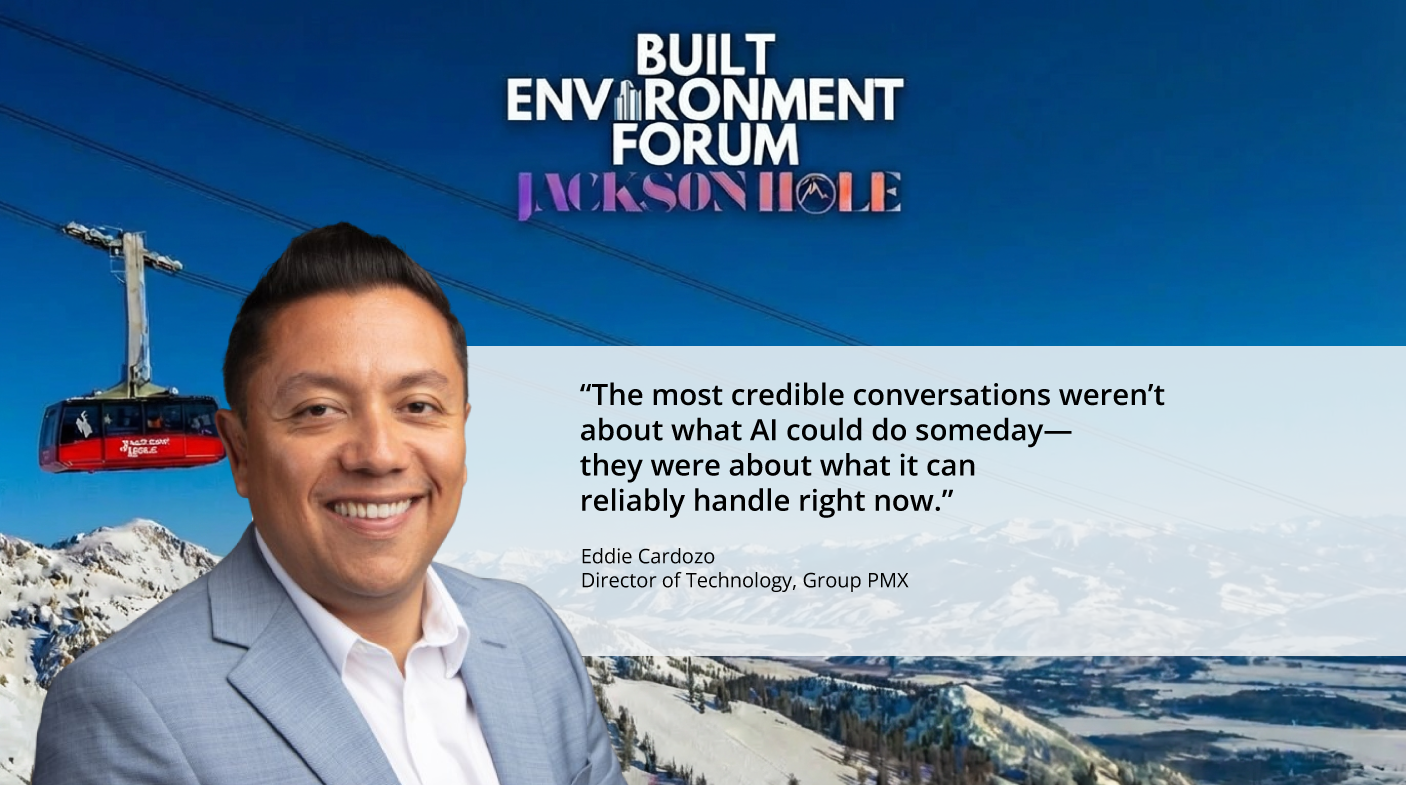
By Eddie Cardozo, Director of Technology, Group PMX
Group PMX Director of Technology Eddie Cardozo attended the Built Environment Forum in Jackson Hole to evaluate the real-world state of innovation across the built environment. In this Insight, he breaks down the most practical themes he heard—from workforce constraints to AI adoption—and what those signals mean for project delivery today.
When people talk about innovation in the built environment, it often comes with a lot of buzzwords—big ideas, futuristic concepts, and technologies that sound exciting but feel distant.
That wasn’t the tone at the Built Environment Forum in Jackson Hole.
The conversations were direct. The problems were familiar. And the solutions—while ambitious—were rooted in what teams are dealing with on real projects right now.
The Workforce Gap Is the Constraint Behind Most Innovation
If there was one topic that surfaced again and again, it was staffing.
The industry does not have enough people to support the volume and complexity of construction underway across the country. That reality is forcing organizations to rethink how work gets done—and it’s one of the biggest drivers behind the innovation we’re seeing today.
What was especially interesting was seeing how different companies are solving the same problem in completely different ways.
Some are pursuing people-first strategies, including AEC-focused recruiting platforms and international programs sourcing qualified talent to fill persistent gaps.
Others are leaning into automation and AI, aiming to reduce workload by removing repetitive tasks that pull experienced professionals away from higher-value responsibilities.
In practice, most of the innovation we heard about wasn’t “AI replacing humans.” It was AI being used to help teams function effectively with fewer resources.
AI Is Shifting from Hype to Use Cases
AI came up frequently throughout the forum—but not in the way it often does.
The strongest conversations were not about futuristic predictions. They were about practical applications, including:
- Automating repeatable project tasks
- Supporting documentation and coordination
- Improving consistency in workflows
- Reducing administrative burden on project teams
Some solutions were early stage. Some were already being tested in real-world environments. And some were still determining where AI is useful versus where it creates noise.
But the direction is clear: AI is moving from “interesting” to “operational.”
Not All Innovation Is Digital
One of the best reminders from the forum was that innovation doesn’t always mean software.
There were examples of construction approaches—particularly in structural and foundation work—that are already delivering major cost savings. These innovations may not come with dashboards or apps, but they have a real impact on how projects are planned, priced, and executed.
That’s important because for owners, the value of innovation isn’t novelty—it’s certainty. The right tools can improve visibility, support better decision-making, and ease pressure on already-stretched project teams. The challenge isn’t whether to adopt technology but how to apply it responsibly, in ways that strengthen delivery rather than introduce new risk.
Robotics, AR/VR, and the Industry Reality Check
There were also candid conversations about where innovation still faces real friction.
Robotics continues to generate excitement, but scaling it within active construction environments remains complex. Job sites are variable and unpredictable. Schedules move fast. Implementation has to make economic sense. While robotic dexterity continues to improve, it still does not match the adaptability and fine motor skills of experienced craft professionals. The gap is narrowing—but it hasn’t closed.
That doesn’t mean robotics won’t play a larger role in the future. It means the industry is still working through where and how it makes practical sense.
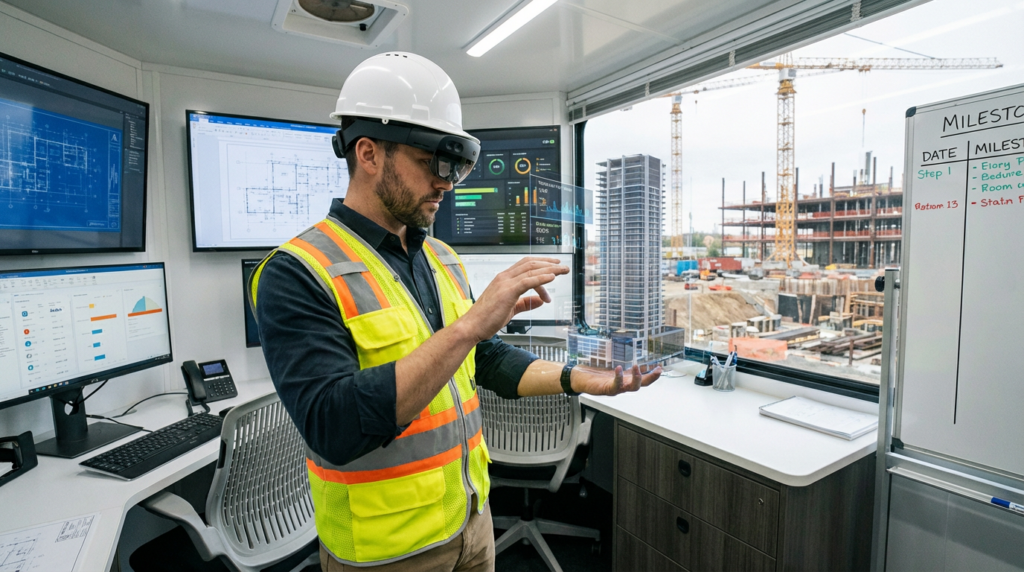
AR/VR and visualization tools, by contrast, are already delivering measurable value. They’re being used to reduce errors, clarify design intent, and improve coordination across disciplines before teams mobilize in the field. These tools aren’t theoretical—they’re embedded in workflows today and continuing to evolve as hardware and software capabilities improve.
What stood out most was the industry’s growing maturity in evaluating innovation. Teams are becoming more disciplined about distinguishing between what’s deployable now, what requires further refinement, and what remains exploratory. That discernment is important.
And seeing how far many of these technologies have advanced in a relatively short period of time is encouraging. It reinforces that progress in this space isn’t incremental by accident—it’s driven by continued experimentation, refinement, and a willingness to push the envelope of what’s feasible.
Why Forums Like This Matter
What made Jackson Hole valuable wasn’t just the content. It was the access.
You’re hearing directly from people who are testing solutions in the field—what’s working, what isn’t, and what still needs refinement. There was very little posturing. People were open about challenges and honest about outcomes.
That kind of transparency accelerates learning. It helps separate trends from tools, and concepts from implementation.
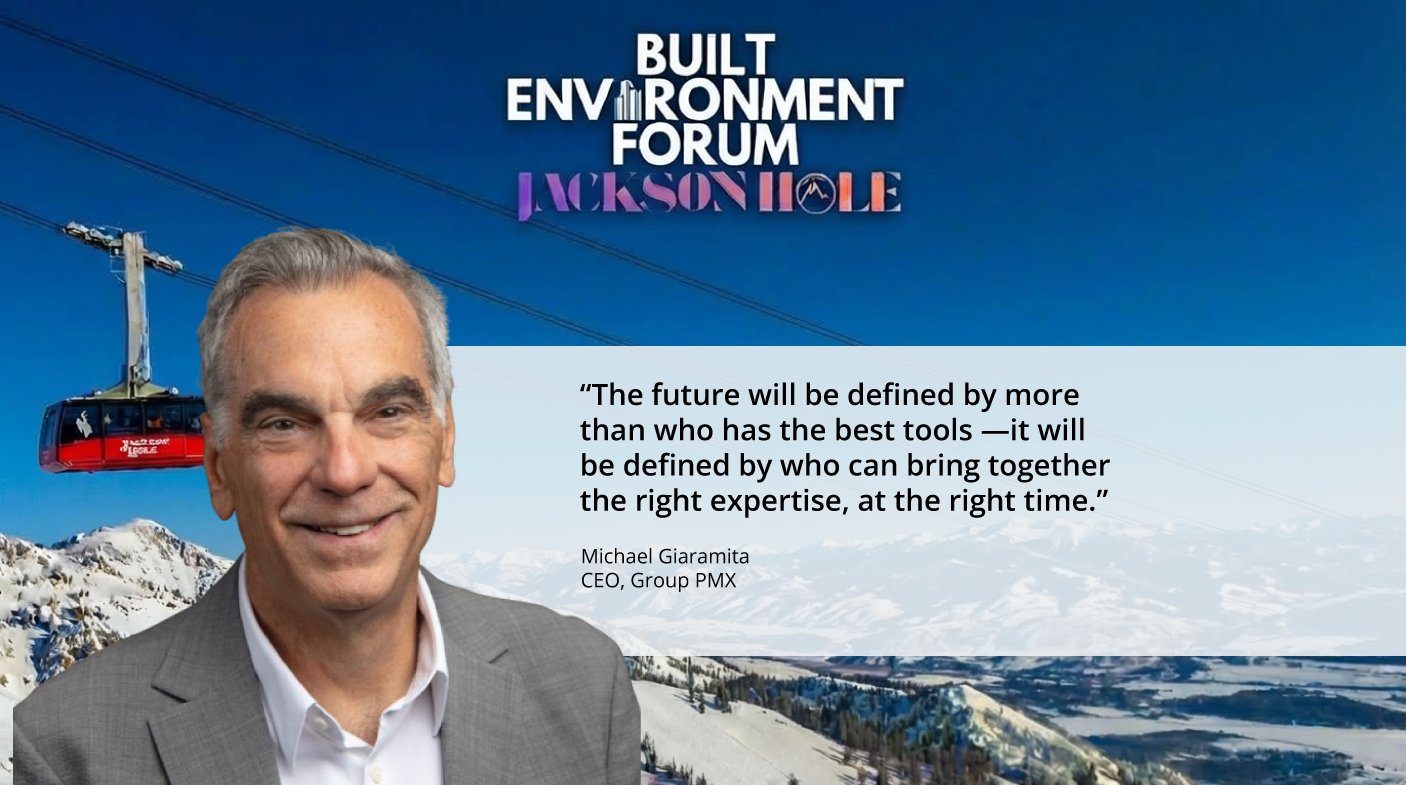
For a broader perspective on why relationship-building and ecosystem thinking may be just as important as the technology itself, read Group PMX CEO Michael Giaramita’s companion Insight: “Becoming an Ecosystem—And We’re Still Early.”
What This Means for Group PMX
At Group PMX, our technology focus remains consistent: apply innovation where it improves delivery, reduces risk, and supports project teams—not where it simply adds complexity.
Jackson Hole reinforced the importance of staying close to real-world constraints, evaluating technology through use cases (not hype), and continuing to learn from others who are testing solutions under the same conditions we operate in.
Innovation in the built environment isn’t one breakthrough moment. It’s a steady shift—and it’s already underway.
Take your next project
to new heights.
Wherever you are with your next project, we’ll help you move forward, faster than ever.