
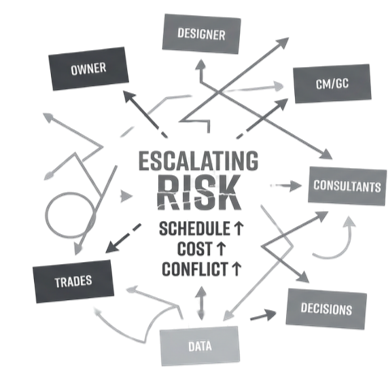
Why risk escalation is structural—and how to address it early
Risk rarely appears all at once.
It builds through misalignment, fragmented decision-making, and unclear accountability.
Risk escalation is not random. It is structural.
Projects drift not because of complexity, but because of how they are structured to operate:
– decision authority is unclear
– governance is fragmented
– accountability is diffused
Over time, these conditions compound.
What appear to be isolated issues—delays, rework, cost pressure—are often the result of structural gaps established early.
Where Risk Forms and How to Address It
If risk is structural, the question is where it is forming.
It typically develops where:
– alignment across stakeholders begins to diverge
– decisions slow or become inconsistent
– reporting does not drive action
– accountability is shared but not owned
High-performing teams address this early by:
– establishing alignment before execution
– defining decision rights and escalation pathways
– integrating schedule, cost, and risk into one view
– using data to drive timely decisions
How Group PMX Approaches This
Group PMX works with owners to address risk at its source by focusing on how projects are structured.
This includes:
– aligning stakeholders early
– defining governance and decision rights
– structuring teams around execution
– using integrated data to guide action
The objective is not simply to manage risk—but to prevent escalation.
If this perspective is relevant, we’re happy to share how we assess where risk is forming on active projects.
Take your next project
to new heights.
Wherever you are with your next project, we’ll help you move forward, faster than ever.