

Healthcare leaders face increasingly difficult capital investment decisions. Changing demographics, evolving care models, reimbursement pressures, and rising costs are making it harder to predict what health systems will need five, ten, or twenty years from now.
These challenges are particularly evident on Long Island, where healthcare systems are expanding and modernizing facilities within a geographically constrained and competitive market. But the questions facing capital decision-makers extend well beyond the region.
How can health systems make investments that meet today’s needs while remaining viable as conditions change?
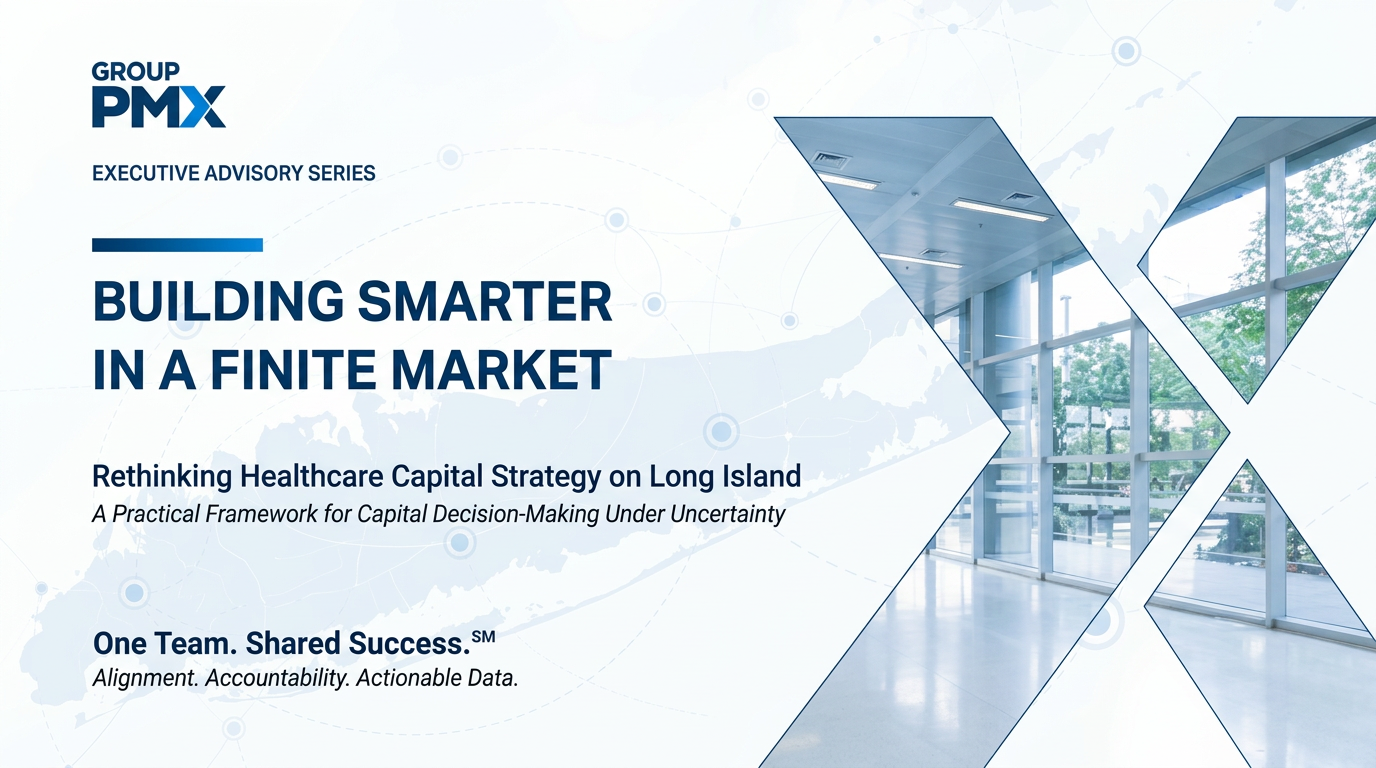
In our Executive Advisory Brief, Building Smarter in a Finite Market: Rethinking Healthcare Capital Strategy on Long Island, we explore questions that should inform major capital decisions—anywhere.
How should hospitals and health systems prioritize capital investments?
Capital projects should be evaluated within the context of the entire healthcare network, not simply on their individual merits. A proposed facility may address a legitimate need, but does it expand access, fill a capacity gap, or primarily shift patients from another location?
Prioritization also requires testing the assumptions behind each investment. Understanding how projects perform under different demand scenarios can help leaders direct limited capital toward investments that offer the greatest long-term value.
How can health systems make better capital planning decisions under uncertainty?
No single forecast can reliably predict how clinical demand, technology, or care delivery will evolve over the life of a healthcare facility.
Rather than planning around one expected outcome, health systems should test investments against a range of plausible scenarios, including lower utilization, changes in service-line demand, and shifts in care delivery. They should also consider whether facilities and infrastructure can accommodate future changes—and whether the additional cost of that flexibility is justified.
How can healthcare organizations reduce risk throughout capital project delivery?
A sound investment decision at project approval does not guarantee that the original business case will remain valid throughout the delivery phase.
Changes in scope, cost, schedule, or clinical requirements can materially affect an investment’s long-term value. Establishing clear decision gates throughout planning, design, procurement, and construction gives leaders opportunities to reassess assumptions, evaluate emerging risks, and make adjustments before commitments become difficult to reverse.
A Practical Framework for Healthcare Capital Decisions
Our Executive Advisory examines five areas that healthcare leaders should evaluate before committing capital: demand, asset suitability, network impact, flexibility, and governance.
It also includes practical questions for executives and capital committees to use when evaluating proposed investments and reassessing them as projects advance.
About the Author
Michael K. Kimura, PE, is Director of Life Sciences & Healthcare at Group PMX and a licensed professional engineer with more than 21 years of experience. He leads complex healthcare capital programs, combining engineering expertise with program management, budget and schedule oversight, risk mitigation, and stakeholder coordination. Michael currently directs NYCEDC’s $1.7 billion FEMA-funded program to restore and strengthen New York City public hospitals and senior care facilities.
READ MICHAEL KIMURA’S FULL BIOGRAPHY
More Insights from Michael Kimura
“Reframing the Construction Manager as a Community Manager” — Healthcare Facilities Today
“Ensuring Successful Capital Project Management” — Healthcare Facilities Today (October 2025)

Take your next project
to new heights.
Wherever you are with your next project, we’ll help you move forward, faster than ever.